

From the ancient savannahs where lions still hunt at dawn to the coral shores of the Indian Ocean’s most beautiful archipelago — Tanzania’s bush and beach safari is the journey that has everything.
Introduction
There is a phrase that recurs constantly in the language of East African travel: bush and beach. Two words, four syllables, and an entire philosophy of travel compressed within them. The bush: wild, ancient, demanding, alive with a biological intensity that no other landscape on Earth can match. The beach: warm, unhurried, sensory, a world governed by tides and trade winds rather than the hunting rhythms of predator and prey. Together, they constitute a travel experience so complete, so satisfying in its contrasts and its coherence, that once you have done both in the same journey, doing only one feels somehow incomplete.
Tanzania is the country that perfects this combination. Nowhere else on the planet does the world’s greatest wildlife wilderness sit within forty minutes’ flying time of a coral island archipelago that ranks among the Indian Ocean’s most beautiful. The Serengeti, the Ngorongoro Crater, the elephant-thronged plains of Tarangire, the remote boat-safari waterways of Nyerere — these are the bush. Zanzibar, with its powder-white beaches, carved-door Stone Town civilization, and turquoise lagoons above extraordinary coral reefs — this is the beach. And Tanzania holds both within its borders, connected by a domestic aviation infrastructure that makes moving between them a matter of hours rather than days.
The Tanzania bush and beach safari is not merely a holiday format. It is a recognition that the human appetite for travel is itself complex — that we want both the profound alertness of the wild and the profound rest of the shore, and that East Africa, uniquely, can provide both within a single seamless journey. This article is your complete guide to understanding, planning, and maximizing a Tanzania bush and beach safari — covering the destinations, the logistics, the optimal timing, the accommodation options, and everything that separates an extraordinary experience from an adequate one.
The Bush: Tanzania’s Wildlife Wilderness in Depth
Why Tanzania Stands Apart
Tanzania protects more land for wildlife conservation than almost any country on Earth. Approximately 38 percent of the country’s total surface area — over 364,000 square kilometers — is designated as national park, game reserve, conservation area, or marine protected area. This extraordinary commitment to conservation is not merely administrative. It is the foundation on which the quality of Tanzania’s wildlife experiences rests, and the reason that a Tanzania bush and beach safari delivers wildlife encounters that no other African destination can consistently replicate.
The country’s safari landscape divides into two distinct circuits, each offering a fundamentally different character of wilderness experience and each pairing naturally with the beach component in different ways depending on traveler priorities and geographic preference.
The Northern Circuit: Icons of African Wildlife
The northern circuit encompasses Tanzania’s most celebrated and most visited wildlife destinations, concentrated in the arc of parks stretching west and south from the safari capital of Arusha. For the great majority of Tanzania bush and beach safari travelers, the northern circuit provides the bush component of the journey — a concentration of world-class wildlife experiences within a relatively accessible and well-developed tourism infrastructure.
The Serengeti National Park is the undisputed centerpiece of the northern circuit and the anchor of virtually every Tanzania bush and beach safari that incorporates the mainland. This 14,763-square-kilometer UNESCO World Heritage Site is home to the Great Migration — the annual movement of over 1.5 million wildebeest, 700,000 zebras, and 500,000 Thomson’s gazelles in a continuous circuit through the ecosystem — and to year-round predator populations that rank among Africa’s densest. The Seronera Valley in the central park delivers reliable lion, leopard, and cheetah sightings on almost every drive, regardless of migration positioning. Three to five nights in the Serengeti is the standard allocation for a bush and beach safari; longer stays reward patience with increasingly rare and extraordinary wildlife encounters.
The Ngorongoro Conservation Area provides the northern circuit’s most concentrated Big Five experience. The volcanic caldera — 260 square kilometers enclosed by walls rising 600 meters, formed three million years ago — is a self-contained ecosystem supporting approximately 25,000 to 30,000 large animals in extraordinary proximity. Lion, leopard, elephant, Cape buffalo, and the rare black rhinoceros coexist within a geographical space that is entirely navigable within a single game-drive day. For bush and beach safari travelers, Ngorongoro offers the certainty of iconic wildlife encounters within a finite time window — making it an ideal anchor for itineraries where the beach component limits mainland time. One to two full crater game-drive days is the standard allocation.
Tarangire National Park rewards the traveler willing to look beyond the headline parks. During the dry season from June through October, the Tarangire River becomes the focal point for elephant gatherings of extraordinary scale — thousands of animals converging from across the ecosystem in slow, unhurried procession. The park’s ancient baobab trees, some estimated at over a thousand years of age, provide a landscape of haunting primordial grandeur. One to two nights makes Tarangire a richly rewarding addition to any northern circuit bush and beach itinerary.
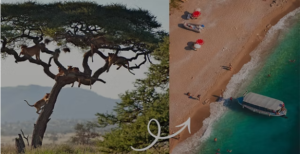
Lake Manyara National Park offers a compact and beautifully diverse half-day or full-day addition to northern circuit journeys. Famous for its tree-climbing lions — a behavioral curiosity found in very few African lion populations — and for the alkaline lake margins where flamingos congregate in their thousands, Manyara is often incorporated as an en-route park on the transfer between Arusha and the deeper northern circuit destinations.
The Southern Circuit: Tanzania’s Wild Frontier
For travelers whose bush and beach journey routes through Dar es Salaam rather than Arusha — or for those returning for a second or third Tanzania safari with a desire for something altogether wilder and more remote — the southern circuit provides a bush experience of a fundamentally different character.
Nyerere National Park, formerly the Selous Game Reserve, is Africa’s largest protected wildlife area — a vast, breathtaking wilderness of miombo woodland, river channels, oxbow lakes, and open floodplains covering over 50,000 square kilometers. The Rufiji River, Tanzania’s mightiest waterway, meanders through the heart of this wilderness, and boat safaris along its channels and lakes provide a dimension of wildlife encounter — intimate, unhurried, conducted from the water’s surface among hippo, crocodile, elephant, and an extraordinary diversity of waterbirds — that is simply unavailable in the northern circuit. Nyerere supports Africa’s largest populations of wild dog, elephant, buffalo, and hippo. Its proximity to Dar es Salaam, and by extension to Zanzibar, makes it the natural anchor of a southern bush and beach combination.
Ruaha National Park is Tanzania’s largest national park by area and its most dramatically undervisited premier destination. Remote, genuinely wild, and encountered by a tiny fraction of the visitors who flood the northern parks, Ruaha offers exceptional lion populations — including unusually large prides of up to thirty individuals — alongside leopard, cheetah, elephant, greater and lesser kudu, and roan and sable antelope not found in the northern circuit. For travelers who have done the northern circuit and want something more raw, more exclusive, and more demanding of the safari spirit, Ruaha is Tanzania’s answer.
The Beach: Zanzibar in All Its Dimensions
The Island’s Cultural Soul: Stone Town
Every Tanzania bush and beach safari that incorporates Zanzibar should include meaningful time in Stone Town — the archipelago’s ancient capital and a UNESCO World Heritage Site of extraordinary complexity and beauty. The old town’s coral-stone buildings, carved wooden doors, mosques and Hindu temples, narrow trading streets, and the convergence of African, Arab, Indian, and Portuguese influences speak to over a thousand years of Indian Ocean civilization. The former slave market and Anglican Cathedral, the Palace Museum, the Darajani spice market, the legendary Forodhani Gardens waterfront food stalls at dusk — together they constitute a cultural experience of genuine depth that provides essential context for the entire Zanzibar chapter of the journey.
A minimum of half a day with a knowledgeable local guide transforms Stone Town from a collection of old buildings into a living narrative of one of the world’s great maritime civilizations. Most experienced operators build a Stone Town guided tour into the first or last day of the Zanzibar component as a matter of course.
Zanzibar’s Beaches: Matching Shore to Traveler
The island’s beaches vary significantly in character, and choosing the right beach for the decompression and recovery chapter of a bush and beach safari meaningfully enhances the overall journey:
Nungwi and Kendwa (Northwest Coast) offer the island’s finest year-round swimming conditions — calm, protected lagoon waters, white sand, excellent restaurants and water sports. Nungwi has an energetic and social atmosphere; Kendwa is quieter and more suited to couples. Both are ideal for travelers who want reliable ocean access and beach comfort immediately after the physical demands of the bush.
Paje and Jambiani (East Coast) provide a quieter, more authentically local Indian Ocean experience. Paje is the world’s premier kitesurfing destination during the southeast monsoon; Jambiani offers almost complete seclusion on one of the island’s most beautiful stretches of shoreline. These beaches suit travelers seeking genuine solitude and direct immersion in Zanzibar’s natural coastal environment.
Pemba Island — Zanzibar’s less-visited northern neighbor — offers the ultimate in Indian Ocean seclusion. Remote, dramatically beautiful, and home to some of the finest diving in the entire western Indian Ocean, Pemba rewards the traveler willing to move beyond Zanzibar Island for a more exclusive and adventurous beach experience.
Marine Wildlife and Ocean Activities
The Indian Ocean surrounding Zanzibar adds a marine wildlife dimension to the bush and beach safari that complements the terrestrial wildlife of the mainland with entirely different encounters of equal magnificence. Snorkeling and diving at Mnemba Atoll Marine Conservation Area delivers encounters with sea turtles, reef sharks, manta rays, whale sharks (seasonally), and extraordinary reef ecosystems of global conservation significance. Dolphin-watching from Kizimkazi provides near-guaranteed encounters with Indo-Pacific bottlenose and humpback dolphins. Traditional dhow sunset sailing connects travelers to the maritime heritage that has defined this island for a thousand years.
Structuring the Perfect Bush and Beach Safari
Essential Itinerary Principles
Four principles guide the design of every successful Tanzania bush and beach safari: sequence, proportion, depth, and transition. Safari first, beach second — complete the wilderness experience at peak energy and allow the beach to serve as a restorative conclusion. Proportion — allocate sufficient time to each destination for genuine immersion rather than rushed overview. Depth — resist the temptation to visit too many parks too briefly; two parks deeply reward far more than four parks visited superficially. Transition — manage the connection between bush and beach through a specialist operator who coordinates all internal flights and logistics into a seamless whole.
Sample Itineraries
7-Night Classic Bush and Beach Days 1–2: Zanzibar — Stone Town, beach introduction, sunset dhow cruise. Days 3–5: Serengeti National Park — Three full game-drive days via direct light aircraft. Day 6: Ngorongoro Crater — Full Big Five crater drive. Day 7: Return to Zanzibar — Final beach day before international departure.
10-Night Northern Circuit Complete Days 1–3: Zanzibar — Stone Town, Mnemba snorkeling, northern beach. Days 4–5: Tarangire National Park — Elephants and baobabs. Day 6: Lake Manyara — Tree-climbing lions, flamingo. Day 7: Ngorongoro Crater — Big Five crater immersion. Days 8–10: Serengeti — Three full migration and predator game-drive days. Return to Zanzibar or departure via Kilimanjaro.
10-Night Southern Circuit Beach and Bush Days 1–3: Zanzibar — Stone Town, east coast beach, dolphin watching. Days 4–7: Nyerere National Park — Boat safari, walking safari, game drives along the Rufiji. Days 8–10: Zanzibar — Northern beach recovery, Mnemba diving. Departure from Zanzibar international airport.
12-Night Honeymoon Signature Days 1–4: Zanzibar — Luxury beach villa, private Stone Town tour, sunset dhow, Mnemba private snorkeling charter. Days 5–9: Serengeti — Luxury tented camp, private game drives, bush dinner, sunrise balloon safari. Day 10: Ngorongoro — Crater rim lodge, full crater drive. Days 11–12: Zanzibar — Return to island, final beach chapter, candlelit seafood dinner on the sand.
Timing Your Tanzania Bush and Beach Safari
January and February represent the dual seasonal sweet spot — Zanzibar’s finest northeast monsoon beach conditions coincide precisely with the Serengeti’s calving season, one of the migration’s most emotionally intense and predator-rich chapters. This window is ideal for first-time visitors wanting maximum impact from both components simultaneously.
June through October delivers dry-season game-viewing reliability across all northern parks, the Serengeti’s iconic Mara River crossings in August and September, and consistently pleasant Zanzibar beach conditions. This is the most popular window and demands the earliest advance booking.
November and December offer excellent shoulder-season value — short rains bring vivid green landscapes and dramatically reduced visitor numbers to the Serengeti, while Zanzibar’s inter-monsoon period provides pleasant if occasionally variable beach weather. Accommodation rates drop significantly and the bush feels more private.
Key Takeaways
- The Tanzania bush and beach safari combines the world’s greatest wildlife wilderness with the Indian Ocean’s most enchanting island destination — a journey of extraordinary sensory and emotional completeness.
- Tanzania protects approximately 38 percent of its total land area for wildlife conservation — the foundation of the exceptional wildlife quality that defines the bush component.
- The northern circuit — Serengeti, Ngorongoro, Tarangire, and Manyara — provides the highest wildlife density and most developed infrastructure for the majority of bush and beach itineraries.
- The southern circuit — Nyerere and Ruaha — delivers greater exclusivity, remoteness, and the unique dimension of boat safaris on the Rufiji River for travelers seeking a wilder experience.
- Safari first, beach second is the universally recommended sequence — completing the wildlife experience at peak energy and using Zanzibar as a restorative, reflective conclusion.
- Zanzibar’s Stone Town is a UNESCO World Heritage Site of profound cultural depth — at minimum half a day of guided exploration should anchor the island chapter of every bush and beach safari.
- Beach selection — Nungwi for swimming and social energy, Paje and Jambiani for seclusion, Pemba Island for diving exclusivity — should reflect the traveler’s priorities for the beach recovery chapter.
- January–February is the dual sweet spot: peak beach weather coincides with the Serengeti’s extraordinary calving season.
- Depth over breadth — two wildlife parks experienced thoroughly deliver a profoundly richer safari than four parks visited superficially in the same time window.
- Always book through a TATO-accredited specialist operator who coordinates the entire bush and beach journey as a single managed itinerary — the quality of logistics design and guide expertise determines the quality of the experience.
Questions & Answers
Q: What is the ideal length for a Tanzania bush and beach safari? Ten to twelve nights represents the optimal total duration for most travelers — three to four nights in Zanzibar and six to eight nights across two to three mainland wildlife parks. This allocation provides enough time in each location for genuine depth of experience rather than a rushed overview. Seven nights is the workable minimum for travelers with limited time: two to three Zanzibar nights and four to five safari nights across one or two parks. Fourteen-night itineraries incorporating three northern circuit parks plus meaningful Zanzibar time represent the gold standard for those with the luxury of sufficient holiday allowance. Whatever the total length, the guiding principle remains constant: never compress a destination so severely that it cannot reveal itself fully.
Q: How do I decide between the northern and southern circuit for the bush component? The decision rests on three factors: access point, experience level, and priorities. The northern circuit — accessed via Arusha and Kilimanjaro International Airport — offers higher wildlife density, more developed accommodation infrastructure, and the Great Migration as its defining spectacle. It is ideal for first-time Tanzania visitors and those for whom certainty of extraordinary wildlife encounters is paramount. The southern circuit — accessed via Dar es Salaam, just a short flight from Zanzibar — offers a genuinely remote wilderness experience, exclusive accommodation, and the unique dimension of boat safaris. It is ideal for repeat visitors, those who have already completed the northern circuit, and travelers who prioritize exclusivity and raw wilderness over convenience. Many dedicated Tanzania travelers ultimately explore both circuits across multiple visits, finding them complementary rather than interchangeable.
Q: What wildlife can I expect to see on a Tanzania bush and beach safari? The northern circuit delivers near-certain encounters with lion, elephant, Cape buffalo, hippopotamus, crocodile, giraffe, zebra, wildebeest, cheetah, and a remarkable diversity of antelope species, raptors, and waterbirds. Leopard and black rhinoceros are present but require patience and experienced guides. Wild dog sightings are the most coveted and least predictable. The southern circuit at Nyerere is particularly distinguished by Africa’s largest wild dog populations, extraordinary hippo and crocodile concentrations, and elephant herds of exceptional scale. Ruaha adds greater and lesser kudu, roan and sable antelope, and lion prides of unusual size. Marine wildlife in Zanzibar’s waters includes sea turtles, reef sharks, manta rays, dolphins, and outstanding reef fish diversity at Mnemba Atoll.
Q: What should I pack for a combined bush and beach safari in Tanzania? Packing for both environments requires thoughtful division. For the bush: neutral-colored safari clothing (khaki, olive, beige — never bright colors), lightweight layers for warm days, a warm fleece for pre-dawn game drives, closed walking shoes or light boots, wide-brimmed hat, high-factor sunscreen, high-DEET insect repellent, and quality binoculars. A telephoto lens of 300mm to 500mm is essential for wildlife photography. For the beach: swimwear, lightweight cotton clothing, sandals, reef-safe sunscreen, and a rash vest for extended snorkeling. An underwater camera or housing captures the Mnemba reef experience. Keep safari and beach luggage in separate soft bags — most light aircraft have strict weight limits of 15 kilograms in soft-sided bags for the bush component.
Q: Is a Tanzania bush and beach safari suitable for a honeymoon? The combination is among the world’s most popular honeymoon itineraries and arguably its finest. The Serengeti’s luxury tented camps offer intimacy, romance, and shared wildlife experiences of profound emotional resonance — private game drives, bush dinners under the stars, sunrise balloon safaris, and nights listening to lions calling across the darkness are experiences that create lasting couple memories of a kind no city hotel can replicate. Zanzibar then provides the ultimate honeymoon beach setting: luxury villas on the Indian Ocean, private snorkeling charters at Mnemba Atoll, sunset dhow sailing, and Stone Town candlelit dinners. Multiple Serengeti properties offer exclusive honeymoon suites and dedicated romantic experiences. Book twelve months in advance for peak season and communicate honeymoon status to your operator for complimentary touches throughout.
Q: How does responsible tourism work in the context of a Tanzania bush and beach safari? Every safari booking is a conservation act when made through the right operator. Tanzania’s national park entry fees directly fund wildlife management, anti-poaching operations, and habitat protection. Choose TATO-accredited operators who employ Tanzanian guides, allocate meaningful revenue portions to community development programs around park boundaries, and partner with accommodation properties that actively support conservation. In Zanzibar, purchase from local artisans and small food vendors rather than resort-only retail. Choose marine operators who adhere to responsible dolphin-watching and snorkeling guidelines. Decline single-use plastics across both components of the journey. Respect all wildlife viewing distances and guide instructions. The cumulative impact of thousands of responsible travelers across a season is measurably significant in terms of conservation funding, community livelihoods, and the long-term political will to protect Tanzania’s extraordinary natural heritage.
Conclusion
The Tanzania bush and beach safari endures as one of the world’s great travel experiences because it answers a question that most holidays cannot: what would it feel like to be fully, completely, and simultaneously nourished by both the wild and the beautiful?
The bush gives you something that modern life rarely does: the experience of being genuinely small within a system that has no interest in your presence and no awareness of your concerns. When a pride of lions walks past your vehicle in the Serengeti’s first light, they are not performing for you. When the wildebeest river crossing builds and breaks and a hundred thousand animals pour into the Mara River, that spectacle has been occurring without human witnesses for hundreds of thousands of years. You are a privileged, temporary observer of something ancient and ongoing. That awareness — of your own smallness, and the corresponding vastness of the natural world — is one of the most valuable things travel can give.
The beach restores what the bush consumes. It returns you to your body — the warmth of the sun, the salt on your skin, the Indian Ocean’s rhythm replacing the savannah’s urgency with something gentler. Stone Town adds history and perspective: this island has been a crossroads of civilizations for over a millennium, has absorbed and adapted and endured, and continues to offer its particular, coral-stone beauty to travelers willing to look slowly and carefully.
Together — the bush and the beach, the savannah and the sea, the lion’s morning walk and the dhow’s crossing at dusk — they constitute a journey that is genuinely, measurably richer than either component alone. Tanzania makes this possible. And those who make this journey return home with something that lasts: a recalibrated sense of proportion, a deeper gratitude for the natural world, and the specific, private memory of two mornings — one on the plains, one on the shore — that they will carry for the rest of their lives.